
Top 5 EIFS Warning Signs in Hampton Roads Homes
The coastal climate here is one of the harshest environments EIFS will ever face. Here’s what every Hampton Roads homeowner needs to know before a small crack becomes a six-figure repair.
EIFS — Exterior Insulation and Finish System — is one of the most energy-efficient and visually versatile cladding systems available. Tens of thousands of homes in Hampton Roads have it. Not sure if your home has EIFS or traditional stucco? Learn the difference between EIFS and stucco here. When it’s installed correctly and maintained, it performs beautifully for decades. When it isn’t — or when early warning signs go unaddressed — the results can be devastating.
The problem is that EIFS fails quietly. Water gets in through a gap you can barely see. It sits behind the foam, against the sheathing, for months or years. By the time you notice something on the inside of your home, the damage is often already structural. See real moisture damage examples from Hampton Roads homes.
Hampton Roads makes this worse. The combination of high humidity, salt air from the Chesapeake Bay and Atlantic coast, hard summer storms, and freeze-thaw cycles in winter creates conditions that stress every component of an EIFS system year-round. See the full list of areas we serve.
These are the five warning signs every Hampton Roads homeowner with EIFS needs to know — and what to do the moment you spot them.
Cracks in EIFS finish coat are not all created equal. Hairline surface cracks from normal thermal expansion are common and largely cosmetic. But cracks that appear at stress points — the corners of windows and doors, at transitions between materials, and at outside building corners — are a different matter entirely.
These locations are where the EIFS system is most vulnerable to movement. When the base coat mesh was not properly lapped and reinforced at these corners during installation, the system has no ability to absorb stress. Cracks develop, and once they do, every rainstorm drives water directly into the gap.
In Hampton Roads, where storms can deliver two inches of rain in an hour with wind-driven lateral pressure, even a hairline crack at a window corner can introduce significant moisture in a single weather event. If you spot cracks, don’t wait — our leak investigation service is designed to find exactly where water is entering.
- Diagonal cracks radiating from the corners of window and door openings
- Cracks that follow the sealant joint line or run parallel just beside it
- Any crack wider than the thickness of a credit card
- Cracks that have dark staining inside them — a sign water has already entered
- Corner bead separation where the wall turns an outside corner
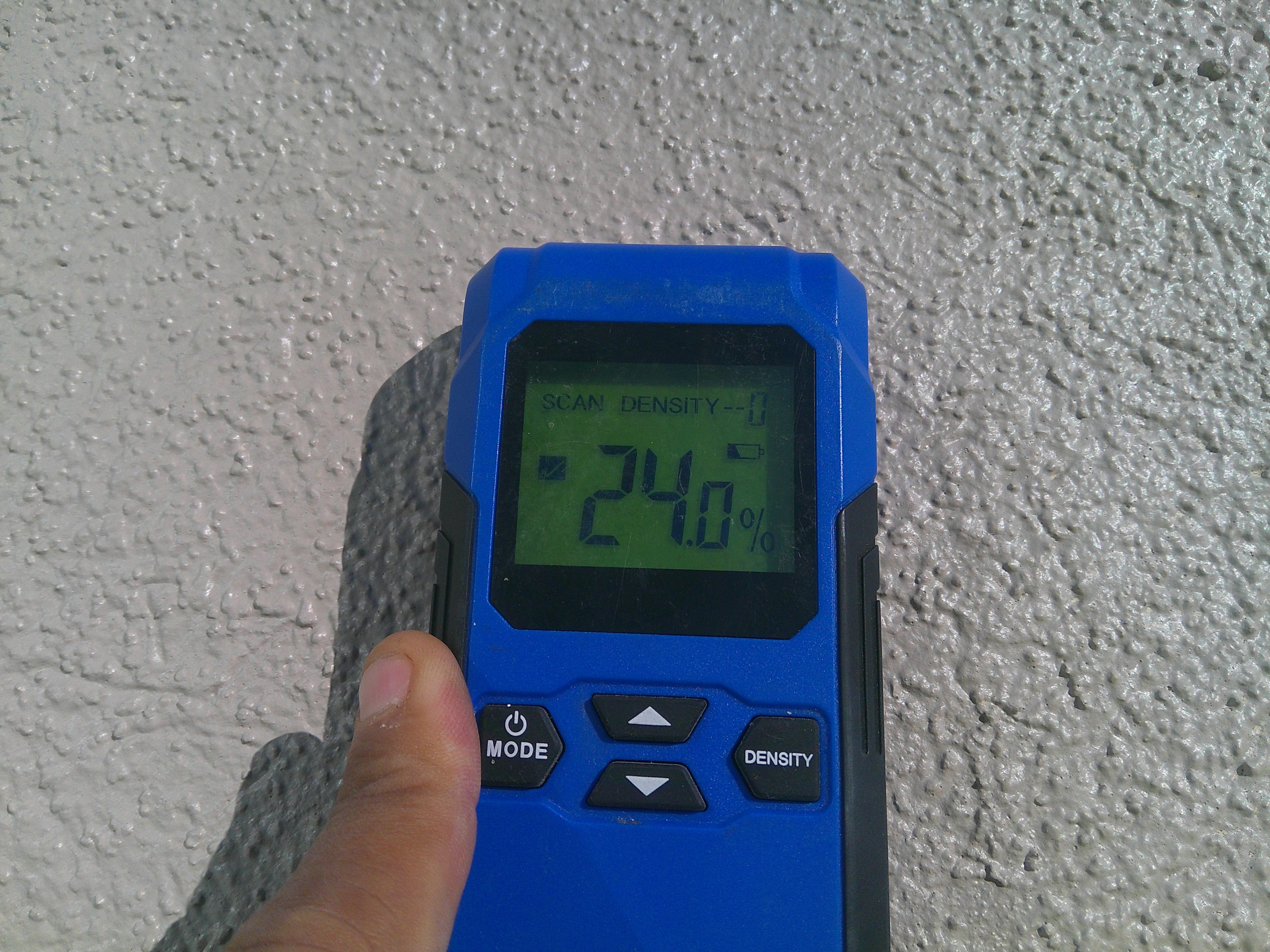
Walk the perimeter of your home and gently press on the EIFS surface with your palm or fingertips in several locations, particularly near the base of walls, around windows, and below any horizontal ledges or sills. The surface should feel firm and solid — exactly like pressing on a hard wall.
If you find a spot that gives slightly under pressure, feels soft, or has any spring to it, water has gotten behind the system. The foam insulation board has absorbed moisture, the sheathing beneath may already be compromised, and in the worst cases, the structural framing itself has begun to rot.
This is the warning sign that inspectors without hands-on experience most commonly misread or dismiss as “minor delamination.” It is not minor. Soft foam is evidence of an active or historic moisture intrusion event, and it will only get worse. Learn what a thorough EIFS inspection actually covers.
- Any give or flex when pressing firmly with your palm
- Sections that feel noticeably different from surrounding areas
- Soft zones concentrated near the base of walls, at sills, or below roof lines
- A hollow sound when you rap gently with your knuckles — solid EIFS sounds dense, not hollow
- Bubbling or blistering on the surface finish above a soft area
“In this climate, moisture doesn’t just visit your walls — it moves in. The question is never whether water will find a way in. It’s whether your system was built and maintained well enough to stop it.”
Sealant joints are the most critical — and most overlooked — maintenance item on any EIFS-clad building. Every penetration through the wall surface: every window, door, hose bib, electrical outlet, light fixture, and pipe, must be sealed where it meets the EIFS. Those seals do not last forever.
Quality sealant in good condition has a service life of roughly 10–15 years under ideal conditions. In Hampton Roads, with UV exposure, salt air, and thermal cycling from hot summers to winter freezes, you should plan on inspecting sealant every 5–7 years and replacing it on a schedule — not waiting until you can see it failing.
By the time a sealant joint looks bad, it has usually been failing functionally for years. A crack in the sealant bead, sealant that has pulled away from one side of the joint, or sealant that has become chalky and lost its flexibility has stopped doing its job completely. Our EIFS maintenance program keeps sealant on a replacement schedule before it fails.
- Sealant that has cracked, torn, or pulled away from the EIFS or window frame
- Missing sealant entirely at penetrations — especially at older utility entries
- Chalky white or chalky gray discoloration indicating UV degradation
- Dark staining in the EIFS finish directly below a sealant joint — water is tracking down
- Gaps visible between sealant and adjacent surface when you look at an angle
- Sealant that is hard and brittle rather than flexible when you press it
EIFS finish coat is designed to be weather-resistant, but it is not immune to surface contamination — and in Hampton Roads, the combination of warmth, humidity, and coastal air creates near-perfect conditions for algae, mold, and mildew to colonize the surface.
Some surface discoloration is purely aesthetic and can be cleaned. Our EIFS cleaning service handles biological growth, staining, and surface restoration safely without damaging the finish coat. But staining patterns matter enormously. Streaks that run downward from windows, sills, or horizontal surfaces indicate that water is consistently pooling and running in those locations — which means there is a collection point for moisture nearby. White chalky deposits — efflorescence — indicate that water is moving through a porous section of the system and carrying mineral salts to the surface as it evaporates.
Both of these are symptoms. The stain on the surface is telling you something about what is happening behind it.
- Green or black biological growth — algae and mold — particularly in shaded areas and near the ground
- Consistent rust-colored streaking below metal flashing, fasteners, or window frames
- White chalky deposits or mineral streaks tracking down from joints or penetrations
- Dark water staining patterns that reappear after cleaning — a sign of an ongoing source
- Surface discoloration directly below horizontal ledges, sills, or roof overhangs
By the time water damage from a failing EIFS system shows up inside your home, the situation has typically been developing for a long time. Interior signs of moisture intrusion — a musty smell in a room with an exterior wall, paint peeling from a wall that shouldn’t be damp, wallboard that feels soft or discolored near a window or exterior corner — are late-stage indicators.
This does not mean the situation is hopeless. It means the repair scope has likely expanded beyond the cladding itself and into the wall assembly — the sheathing, insulation, framing, and interior finishes. Our EIFS repair and construction management service handles the full scope, from cladding through interior remediation. Catching it now still prevents further structural damage, and in many cases the scope is still manageable.
What it does mean is that any EIFS home in Hampton Roads that has gone more than five years without an exterior inspection should be looked at by someone with genuine installation experience — before the signs make it inside.
- A persistent musty or earthy smell in any room with an exterior EIFS wall
- Paint bubbling, peeling, or discoloring on interior walls near exterior corners or windows
- Drywall that feels soft, spongy, or shows discoloration near exterior walls
- Visible mold growth on interior surfaces adjacent to an exterior wall
- Floors that feel soft or springy near exterior walls — possible indication of subfloor rot at the base of the wall assembly
Quick reference: the 5 warning signs at a glance
| Cracks at windows, doors & corners | Highest risk water entry points; act immediately regardless of crack width |
| Soft or spongy wall surface | Moisture already behind the system; foam and sheathing likely compromised |
| Failed or missing sealant joints | Functionally open gaps at every penetration; replace on a 5–7 year schedule |
| Surface staining & biological growth | Symptom of a moisture source nearby; investigate the pattern, not just the stain |
| Interior damp signs near exterior walls | Late-stage indicator; damage has extended into the wall assembly — assess now |
The right time to get an inspection is before you see any of this
Every one of these warning signs is easier and cheaper to address the earlier it’s caught. A failed sealant joint caught during an EIFS inspection costs a few hundred dollars to fix properly. The same joint left unaddressed for three years of Hampton Roads storms can cost tens of thousands in sheathing replacement, framing repair, and interior remediation.
If your home has EIFS and it’s been more than five years since it was professionally evaluated, the inspection is the investment. Everything else is the consequence of skipping it. See our current inspection pricing — inspections are scheduled within 48 hours in Norfolk, Virginia Beach, Chesapeake, and surrounding areas.
Related resources from Modern Wall Systems
See something on this list? We can tell you exactly what you’re dealing with.
Modern Wall Systems brings hands-on EIFS installation and remediation experience to every inspection in Hampton Roads. We don’t just read walls — we’ve built them, repaired them, and know exactly where this climate attacks them first.
Schedule Your Inspection